
New Sod Watering Schedule
Newly laid sod needs a lot of water at first and then gradually less, so the roots grow down into the soil. Enter your install date, weather and sprinkler output, and get a day-by-day watering plan for the first four weeks that you can print and put on the fridge.
- Free to use
- No sign-up
- Runs in your browser
Build a new sod watering schedule
New Lawn Care Planner
Printable 8-week new lawn calendar, sprinkler catch-cup test sheet, fertiliser and mowing log, and a season-long watering workbook.
- Sprinkler output & watering workbook (XLSX, PDF)
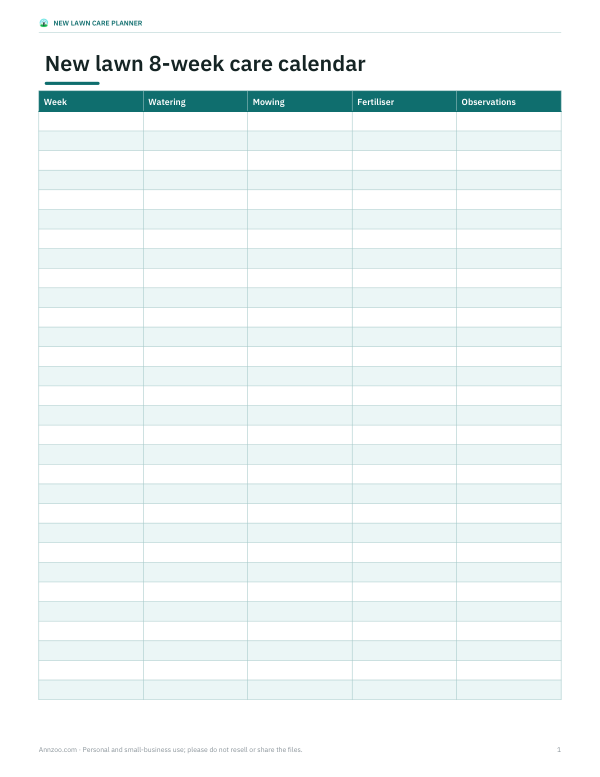
- 8-week calendar (PDF, DOCX)
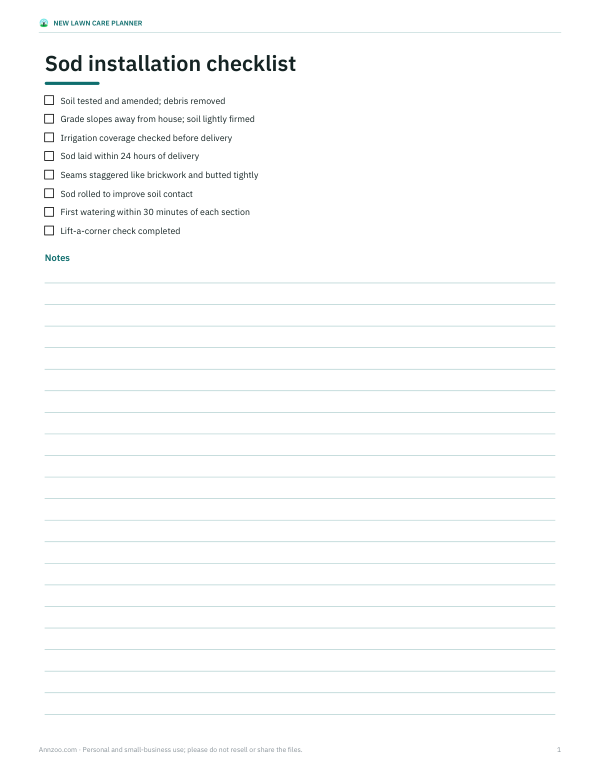
- Installation checklist (PDF, DOCX)
Formats: XLSX, PDF, DOCX. Instant download after payment (link valid 72 hours, up to 5 downloads). AI-assisted: the templates were drafted with AI help and reviewed and laid out before publishing.
$4.00 USD, one-time 3 files · about $1.33 each
- Instant download
- 7-day refund
- Secure checkout by Stripe
7-day money-back guarantee. Full refund within 7 days of purchase, even after you download.
Full refund within 7 days — see the refund policy and license.
Free printables
Single sheets you can print right now, no sign-up. The full pack adds every sheet in one download plus the editable files.
Why new sod needs a special watering plan
Sod arrives as a thin mat of grass with shallow roots cut from a turf farm. For the first couple of weeks it cannot draw water from the soil below, so it depends completely on you to keep it moist. As new roots grow down into the soil — usually within 10 to 14 days in the growing season — the aim changes: water less often but more deeply, so the roots follow the moisture downward. A lawn watered lightly every day for months stays shallow-rooted and struggles in heat and drought. The schedule on this page follows that progression in four stages.
The four stages at a glance
| When | How often | Goal |
|---|---|---|
| Day 1 (installation day) | Immediately, then again later if hot | Soak sod and 3–4 inches of soil below; water within about 30 minutes of laying each section |
| Days 2–7 | 1–3 short sessions a day | Keep sod and soil surface constantly moist; never let it dry out |
| Days 8–14 | Once a day, longer | Encourage roots into the soil |
| Days 15–21 | Every other day, deeper | Train roots to go deeper |
| Days 22–28 and beyond | Every 2–3 days, then weekly | Move to normal lawn watering of about 1 inch per week including rain |
Hot, dry or windy weather and sandy soil speed up drying, so the schedule adds sessions or minutes; cool weather and clay soil slow drying, so it reduces them.
How to check you are watering enough
- Lift a corner: in the first week, gently pull back a corner of a piece of sod. The soil underneath should be moist, not dry and not muddy.
- Look at the seams: edges and joints dry first. Grey-green colour, curling edges or visible gaps mean more water is needed.
- Footprint test: grass that stays flattened after you walk on it is short of water — but avoid walking on new sod as much as possible.
- Tug test from week two: gently pull on the grass. Resistance means roots have started to knit into the soil.
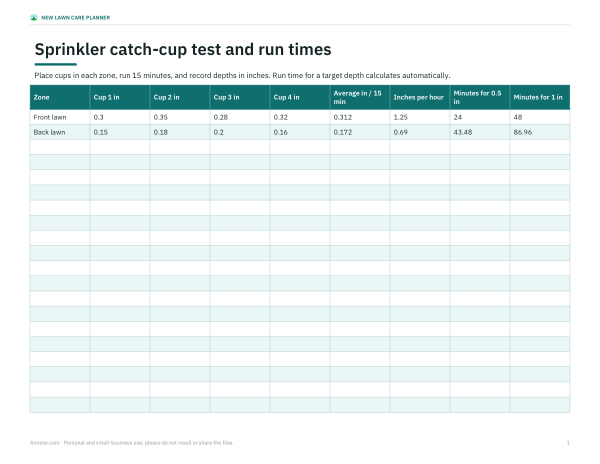
- Catch-cup test: set a few straight-sided cups or tuna cans on the lawn and run the sprinklers for 15 minutes to measure how many inches per hour your system applies.
Worked example
Sod laid on a warm 85 °F day on loam soil with spray-head sprinklers gets a thorough soak on day 1 of about 10 minutes per zone, repeated in the afternoon. On days 2–7 the plan calls for two sessions a day of about 6 minutes per zone — enough to keep the surface moist without puddling. From day 8 the sprinklers run once a day for about 12 minutes, from day 15 every other day for about 20 minutes, and from day 22 every two or three days for about 30 minutes, moving toward a normal weekly total of about an inch of water.
Best time of day to water
Early morning, before about 10 a.m., is best for the main session: less water evaporates, winds are usually calmer and the grass dries during the day, which reduces the risk of fungal disease. During the first week in hot weather an additional early-afternoon session helps keep the sod from drying out. Avoid watering in the evening if you can, since grass that stays wet overnight is more prone to disease.
Mowing and walking on new sod
Keep foot traffic, pets and children off new sod as much as possible for the first two weeks. Mow for the first time when the roots have knitted — usually 10–14 days after installation — and the grass is about a third taller than your target height. Use a sharp blade on a high setting and remove no more than a third of the blade height. Let the lawn dry slightly before mowing so the mower wheels do not leave ruts.
Common problems
- Yellow or brown sod: usually too little water, especially at seams and edges; increase sessions.
- Mushrooms or a sour smell: often too much water, especially on clay; reduce minutes and check drainage.
- Gaps between pieces: sod shrinks when it dries; fill gaps with topsoil and keep moist.
- Sprinkler coverage gaps: corners and areas near buildings often miss out — hand-water them.
- Runoff on slopes: use shorter cycles separated by 30–60 minutes so water soaks in.
Grass type and season
Warm-season grasses such as Bermuda, zoysia and St. Augustine establish fastest when laid in late spring and summer, when they are actively growing. Cool-season grasses such as tall fescue and Kentucky bluegrass establish best in early autumn or spring. Sod laid in hot midsummer weather needs the most water and attention; sod laid in cool weather roots more slowly but needs less frequent watering. Local watering restrictions sometimes include exemptions for new landscaping — check with your water provider.
After the first month
Once the sod has rooted, water established lawns deeply and infrequently: typically about an inch of water per week from rain and irrigation combined, applied in one to three sessions depending on soil and heat. Adjust through the seasons — less in cool weather and after rain, more in heat waves — and watch for the same signs of stress. A rain gauge and a smart or weather-based controller make this much easier.
Frequently asked questions
How often should I water new sod?
Usually one to three short sessions a day in the first week, once a day in the second week, then every other day and gradually less.
How long should I water new sod each time?
Long enough to keep the sod and the top few inches of soil moist — often 5–15 minutes per zone for spray heads in the first week, longer as sessions become less frequent. Measure your sprinkler output for accuracy.
Can I overwater new sod?
Yes. Constantly soggy soil can rot roots and encourage disease, especially on clay. Moist, not muddy, is the goal.
When can I walk on new sod?
Keep traffic to a minimum for about two weeks, until the roots have knitted.
When should I first mow new sod?
Usually 10–14 days after installation, once it resists a gentle tug and has grown about a third above your mowing height.
Should I water new sod in the rain?
Skip sessions after heavy rain, but light rain may not be enough; check the soil under a corner.